

Commentary
Alexander Baunov
{
  "authors": [
    "Alexander Baunov"
  ],
  "type": "commentary",
  "blog": "Carnegie Politika",
  "centerAffiliationAll": "",
  "centers": [
    "Carnegie Endowment for International Peace",
    "Carnegie Russia Eurasia Center"
  ],
  "englishNewsletterAll": "",
  "nonEnglishNewsletterAll": "",
  "primaryCenter": "Carnegie Russia Eurasia Center",
  "programAffiliation": "",
  "regions": [
    "Russia",
    "Europe",
    "China",
    "United States"
  ],
  "topics": [
    "Foreign Policy",
    "Security",
    "Global Governance",
    "Arms Control"
  ]
}
Source: Getty
The concrete goal of an end to the hostilities in Ukraine has been replaced by a host of vague Russian demands concerning a range of issues and regions.
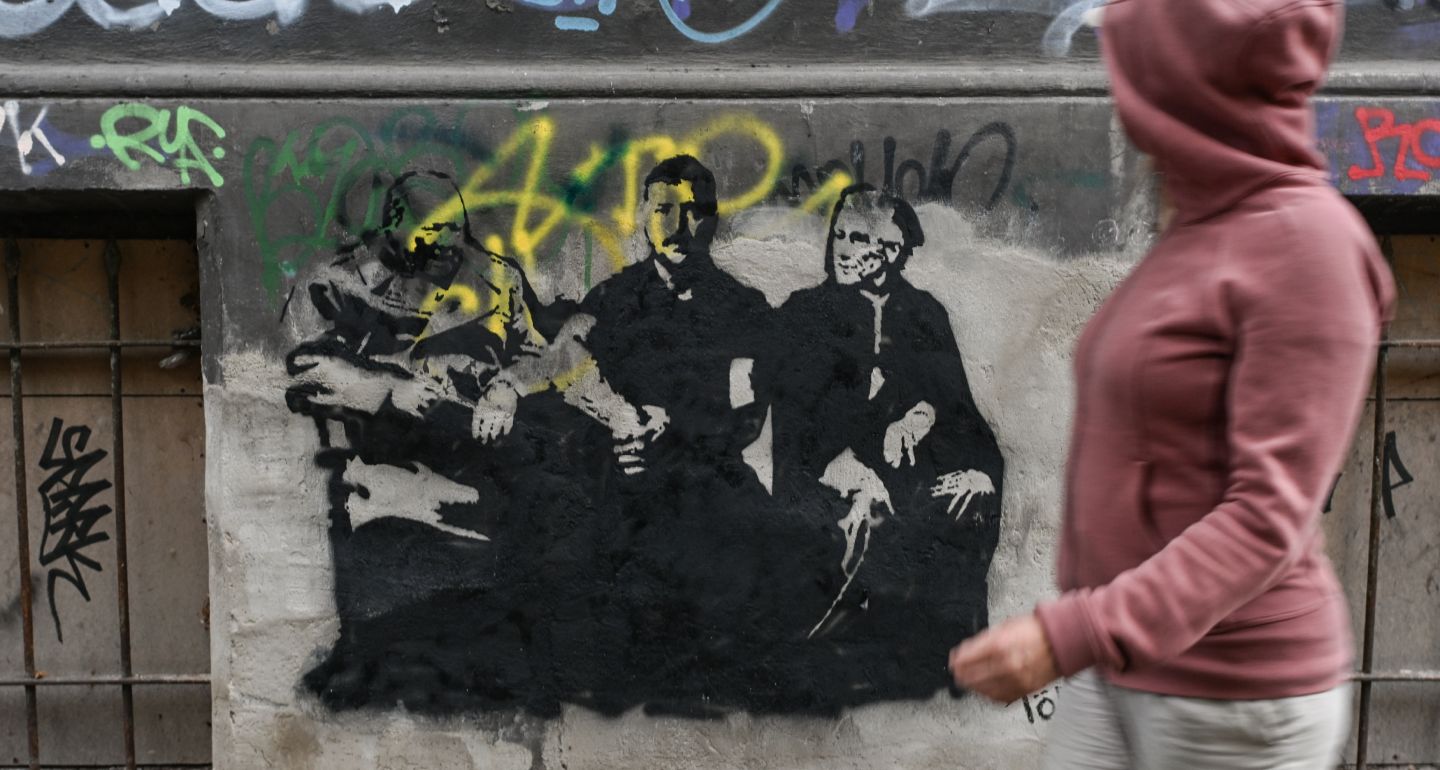
A few days ago, while visiting an exhibition of Orthodox Russian religious art in central Moscow, Russian President Vladimir Putin spent some time in front of a bronze sculpture depicting Joseph Stalin, Winston Churchill, and Franklin D. Roosevelt at their historic 1945 meeting in Yalta to discuss the post-war organization of Europe. A new Yalta conference dividing up Europe has long been Putin’s dream, and now that a trilateral meeting between him, U.S. President Donald Trump and Chinese leader Xi Jinping has finally been arranged, he has secured the right format. He has turned negotiations on the war in Ukraine into preparations for his own imagined Yalta-style triumph.
It may seem that the frenetic diplomatic activity of this fall is bringing the end of the war closer. But activity does not necessarily mean effectiveness, and sometimes it can even push peace further away. Under Russia’s influence, the current diplomatic process, much like Soviet agriculture, is developing along a long and winding path that values expansion over efficiency. The acreage grows, but the yield does not. In today’s case, what is expanding is the range of issues under negotiation.
Not long ago, the resumed talks were seen as an effort to end Russia’s war against Ukraine, and the main obstacle was Moscow’s demand that Ukraine cede the parts of the Donetsk region not yet controlled by Russian forces. Now, after days of diplomatic meetings, the main issue under negotiation is the new European order, from the Danube to the Oder. For obvious reasons, Russia’s interlocutor in such talks is no longer Ukraine but the “collective West.” The United States has turned from a mediator into a party to the talks, drawing Europe into negotiations over its own future. Ukraine is now a detail in a larger picture, but stopping its destruction has become harder, not easier. How did this happen?
Since last summer, Russians have begun to feel the hardships of the war: internet blackouts, airport closures, fires at warehouses, and fuel shortages. Putin’s image as a strong leader who knows where he is taking the country has waned, while the war itself has passed a psychologically important benchmark, having lasted longer than either world war did for Russia. Western governments decided that Russia might be more inclined to compromise and that this was an opportunity to resume talks on ending the war. Alongside the usual calls between Putin and Trump and meetings with U.S. envoys, there have been some new developments: a summer visit to Russia by the CIA director, calls to Putin from the French and Finnish presidents and Norwegian prime minister, a short-lived local ceasefire in Oleshky, and a trilateral format: for the first time, Ukrainian, Russian, and U.S. delegations sat down at the same negotiating table, with Russia’s interlocutors trying to take a more creative approach.
This creativity took the form not only of a search for a line along which the fighting could stop, but also of the obvious idea of compensating Moscow for giving up its claims to Ukrainian territories.
The idea of giving Putin something symbolic instead of the Ukrainian territory he claims but does not control may be rational under certain conditions. But it seems that the U.S. negotiators have lost the initiative and allowed Putin to voice his maximalist demands, making them part of the negotiating agenda. The concrete goal of an end to the hostilities in Ukraine and negotiations on the terms of peace has been replaced by a host of vague Russian demands concerning a range of issues and regions.
This is also what happened a year earlier in Anchorage, when the United States followed Russia’s lead, accepted its agenda, and fruitlessly broadened the scope of the negotiations. Last August, Trump invited Putin to Alaska with the seemingly clear goal of persuading him to end hostilities in return for sanctions relief and “trade.” Two large economic delegations accompanied the leaders. Instead, the Americans returned from Anchorage having accepted Putin’s formula: What was needed was not a ceasefire, but a “comprehensive peace agreement” that addressed the “root causes” of the conflict, for which negotiations could proceed without a halt to the hostilities.
In the present iteration, instead of a demand to give up part of Ukraine, there is now a demand to give up part of Europe by rolling back NATO’s collective military infrastructure to its pre-1997 limits. At the same time, Moscow has not dropped its territorial claims in Ukraine. Putin once again confirmed to Trump’s envoys Jared Kushner and Steve Witkoff that he was prepared to end hostilities only along what he imagines to be Russia’s new state border.
The Europeans, who had been awaiting the outcome of the trilateral talks between the United States, Russia, and Ukraine, have suddenly discovered that they themselves are on the agenda and that in order to get a seat at the table, they have to accept this condition. Otherwise, they will be blamed for the continued suffering of Ukrainians. Poland will be blamed if it refuses to remove Western troops from its territory, Finland if it remains in NATO, France if it continues to extend its nuclear umbrella to other European countries—and who knows what else.
The general idea of a new Yalta is clear. Today’s great powers are to rearrange the world, and Russia is to regain at least some of its former influence over the parts of Europe it once controlled. But the rationale for the original Yalta was clear: a shared victory over a ruthless enemy. Now there is no such basis, and Putin is trying to create one by steering the negotiations on Ukraine along a longer path—first in Anchorage, now in Abu Dhabi. For Putin, the need to end the war in Ukraine now provides a rationale for dividing Europe. If Europe does not allow itself to be divided, the bloodbath will continue.
Senior Fellow, Editor-in-Chief, Carnegie Russia Eurasia Center
Baunov is a senior fellow and editor-in-chief at the Carnegie Russia Eurasia Center.
Recent Work
Alexander Baunov
Alexander Baunov
Carnegie does not take institutional positions on public policy issues; the views represented herein are those of the author(s) and do not necessarily reflect the views of Carnegie, its staff, or its trustees.
It’s a testing time for Russia’s policy in Serbia and the wider region, but it would be premature to conclude from one political setback that the days of Russian influence are over.

Dimitar Bechev
There are limits as to how far the shift in South Korea’s foreign policy will go.

James D.J. Brown
A gas deal would create palpable economic value, but it wouldn’t fundamentally change the position of either Russia or the EU.
Sergey Vakulenko
Russia’s banking sector is sinking ever deeper into a crisis that the authorities are simply managing rather than trying to fix.
Alexander Kolyandr, Alexandra Prokopenko
The war does threaten Putin’s existence. That is why he does not negotiate.
René Nyberg