

Commentary
Alexander Gabuev
{
  "authors": [
    "Alexander Gabuev"
  ],
  "type": "commentary",
  "blog": "Carnegie Politika",
  "centerAffiliationAll": "",
  "centers": [
    "Carnegie Endowment for International Peace",
    "Carnegie Russia Eurasia Center"
  ],
  "englishNewsletterAll": "",
  "nonEnglishNewsletterAll": "",
  "primaryCenter": "Carnegie Russia Eurasia Center",
  "programAffiliation": "",
  "regions": [
    "Southeast Asia",
    "Russia"
  ],
  "topics": [
    "Global Governance",
    "Trade",
    "Foreign Policy"
  ]
}
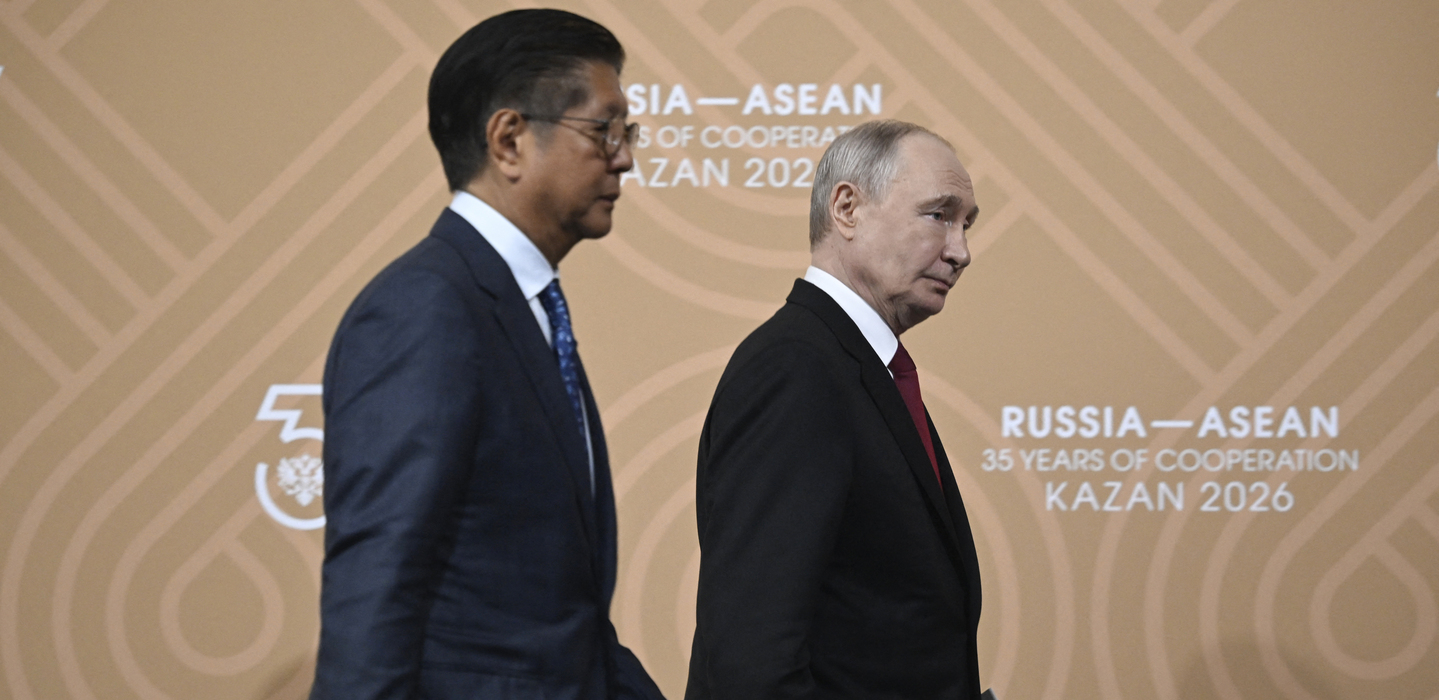
Source: Getty
Russia looks set to reap economic benefits from closer ties with Southeast Asian countries that are keen to find reliable energy suppliers and diversify trade ties.
For most Russians, June 18, 2026, will be remembered as the day when Moscow experienced one of the most spectacular Ukrainian drone attacks to date. Images of an explosion lifting the roof of an oil storage tank into the air in the Russian capital quickly went viral—as did some of the ironic responses to a question posed online: Where was President Vladimir Putin when all this was happening?
The answer to that question was that Putin was taking part in a summit between Russia and the eleven nations of the Association of Southeast Asian Nations (ASEAN) in Kazan. For many, the summer was most memorable for the contrast between the dramatic events in Moscow and Putin’s thanks to Laos Prime Minister Sonexay Siphandone for a gift of two elephants. “You can rest assured that they will be kept in the best conditions and will bring very much joy to all animal lovers,” Putin told Siphandone.
Nevertheless, the summit was also one of the Kremlin’s biggest diplomatic successes since the full-scale invasion of Ukraine in 2022. Despite Western sanctions, a lack of progress on the battlefield, growing economic problems, and more frequent Ukrainian drone attacks, Putin was able to gather the leaders of one of the world’s most dynamic regions, representing more than 700 million people and about 9 percent of global GDP growth.
The explanation is simple: U.S. President Donald Trump’s war against Iran has created major problems for the countries of Southeast Asia, forcing them to seek alternative sources of hydrocarbons and fertilizer. One of their solutions has been to turn to Moscow. In addition, growing competition between the United States and China is pushing the region to deepen ties with other influential countries, making Russia a desirable partner even though it’s engaged in a major war and operating under Western sanctions.
ASEAN countries are an important market for Russian exports: not only oil, gas, and fertilizers, but also weapons and nuclear power equipment. And Moscow knows it must rapidly build trade, technological, and financial ties with the Global South if it wants to sustain its confrontation with the West. One of the results of this push in recent years has been a deepening reliance on China—making Russia so dependent that the Kremlin is beginning to worry. In a search for new allies, it’s unsurprising that Russia is looking at Southeast Asia, where economies are growing and the need for raw materials is huge.
The turnout in Kazan was impressive: Nine of eleven heads of state from ASEAN were present, along with the Indonesian foreign minister and a special representative from Myanmar. Above all, these men decided to make the long journey to Russia because of U.S. and Israeli attacks on Iran causing higher prices for energy and fertilizer. Aside from Brunei, all ASEAN members import energy—and most of them don’t have the ninety-day reserves held by the Organisation for Economic Co-operation and Development states.
Even if Iran and the United States do reach a ceasefire, the risk of hostilities restarting is likely to remain high. Which only makes it more imperative for ASEAN to make deals with alternative suppliers, including Russia. It was unsurprising, therefore, that one of the documents signed as a result of the summit was a joint statement on energy cooperation.
For the Kremlin, the summit was a diplomatic triumph comparable to the 2024 BRICS summit in Kazan, which had successfully demonstrated to the world that the leading nations of the Global South were unbothered by Russia’s diplomatic isolation.
If the BRICS event took place amid economic growth and Kremlin optimism about the military situation in Ukraine, ASEAN delegates gathered as the costs of the fighting become increasingly visible in Russia. Nevertheless, Moscow was still able to use the war in the Middle East to leverage its role as an energy supplier into a symbolic victory.
It was also important for the Kremlin that none of the documents signed at the summit mentioned the war in Ukraine. Neither did attendees raise the topic during negotiations—at least in the parts open to the public. Although Singapore imposed sanctions on Russia for its full-scale invasion of Ukraine, Singaporean Prime Minister Lawrence Wong told Putin that his country valued “our relationship with Russia, the government of Russia, and the people of Russia.” Predictably, Russian state media outlets had a field day with Wong’s comments.
As far as we know, the practical results of the summit were modest, with no announcements of new commercial contracts. However, if you look at the participants of Putin’s meetings, it’s obvious such contracts were discussed behind closed doors. One of those at Putin’s meetings with the prime ministers of Vietnam and Malaysia, for example, was Dmitry Shugayev, who oversees arms exports as the head of Russia’s Federal Service for Military-Technical Cooperation. Both Hanoi and Kuala Lumpur are major, long-standing clients of Russian state arms exporter Rosoboronexport, and Moscow is clearly interested in deepening those ties.
Of course, Russia’s ability to export weapons at the moment is limited by the acute need of its armed forces in Ukraine. But Russia is clearly counting on turning its sprawling defense sector into a source of hard currency once the fighting comes to an end. New products that have been tested in Ukraine, as well as modernized Soviet hardware, will likely be marketed as having successfully withstood a NATO-armed country.
Despite all this, it needs to be remembered that ASEAN will not become a counterweight to Russia’s dependence on China. In 2025, Russia’s trade with ASEAN countries was worth about $22 billion—compared to $228 billion with China.
Moscow’s ability to increase exports to South East Asia is restricted by a poorly developed transport infrastructure in the Far East and the Arctic; ASEAN countries are not rushing to invest in Russia, where a wave of property distribution caused by the Ukraine war is only gaining momentum; Western sanctions are unlikely to be lifted soon; and there are ongoing difficulties with payments (Moscow has only resolved these with Vietnam).
The strengthened ties that Russia has sought with ASEAN nations since the start of the fighting in Ukraine in 2014 would have been much easier to achieve without war, without Western sanctions, and without the pressing need to develop these ties as a substitute for relations with the West.

Director, Carnegie Russia Eurasia Center
Alexander Gabuev is director of the Carnegie Russia Eurasia Center. Gabuev’s research is focused on Russian foreign policy with particular focus on the impact of the war in Ukraine and the Sino-Russia relationship. Since joining Carnegie in 2015, Gabuev has contributed commentary and analysis to a wide range of publications, including the Financial Times, the New York Times, the Wall Street Journal, and the Economist.
Recent Work
Alexander Gabuev

Alexander Gabuev, Temur Umarov
Carnegie does not take institutional positions on public policy issues; the views represented herein are those of the author(s) and do not necessarily reflect the views of Carnegie, its staff, or its trustees.

Russia’s ruling party would have benefited from Putin appearing as its distant patron, but as an active frontman imposing his views on the public, he has done nothing but harm both the party’s election campaign and the ruling system overall.

Andrey Pertsev

Depleted financial reserves and a shrinking tax base mean it is no longer possible to simultaneously deliver high defense spending, price stability, and economic growth.

Alexandra Prokopenko

Blurring the line between humans and animals is a long-standing tradition in social utopian prose. In his latest novel, Leonid Bershidsky reminds us that in social experiments, people are often treated no differently than animals.

Alexander Baunov
While France and Australia are seeking to establish the legal obligations of messaging apps like Telegram, Russia wants total subordination.

Maria Kolomychenko
The recent uncovering of Dmitry Donskoy’s relics in the Cathedral of the Archangel is yet another attempt by the Russian Orthodox Church to help the state solve its problems. However, parroting the state’s version of Russian history leaves the Church with no message except “patriotism.”
Alexander Zanemonets