

Paper
America’s foreign-policy objectives have grown more demanding while Americans have demanded greater focus on their own affairs.
Stephen Wertheim
Source: Getty
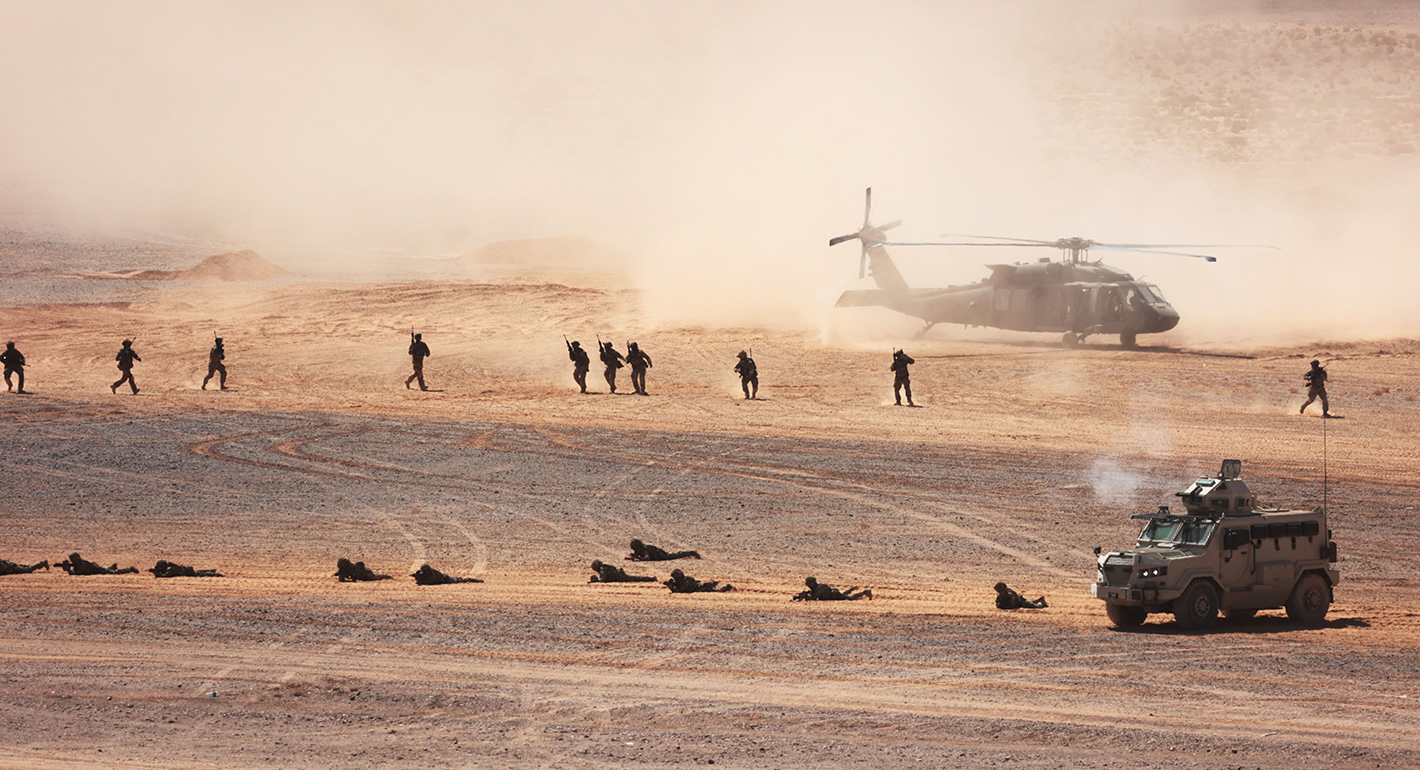
An overreliance on coercive military action has moved the United States further from its goals in the Middle East and North Africa.
The United States’ presence in the Middle East and North Africa (MENA) can be explained by its pursuit of free trade, for which securing waterways, stabilizing energy markets, and protecting its allies are paramount. However, since 2003, the United States has been increasingly ineffective in its pursuit of these goals. While the burgeoning multipolar regional order and the rise of great power competition have contributed to the decline of U.S. influence in MENA, it is the country’s unrelenting overreliance on military might that has proven the biggest accelerator of its downfall.
Indeed, while militarily, the United States remains unrivaled, military power is merely one of several power bases at Washington’s disposal.1 U.S. power in MENA is actually distinguished less by its military might than by diplomatic maneuvering and economic dynamism. In the face of rising competition with China and continuous disruptive Russian policies, Washington will need to reprioritize its power bases. If it fails to realign its presence with its aims, Washington will continue to flounder, wasting valuable resources, and further damaging its credibility in the region.
The geostrategic landscape in MENA has changed significantly since the invasion of Iraq. Both the emergence of regional middle powers and growing great power competition have made decisive military victories more elusive, diversified trade and economic cooperation, and created new security needs for MENA that the United States can no longer fulfil on its own.
Since 2003, Washington’s foreign policy decisions—often made on faulty assumptions about the efficacy of military power alone—have weakened the U.S. position in MENA. From Iraq to Afghanistan, Syria to Libya, and Yemen to Iran, America’s use of military tools has had an overall destabilizing effect on the region. Not only has this drawn the United States into sustained conflicts, but it has endangered Israel, which Iran and its proxies increasingly target. It has also threatened the Gulf allies who have been targeted by Iran since the start of the war. As warfare evolves in MENA and decisive victories become increasingly elusive, the military as a U.S. base of power may continue to lose relative importance. When lacking international support, military engagement in the region has instead moved Washington further from its aim of securing free trade.
For the United States, diplomacy has proven to be its most distinctive, and perhaps most important, source of power in MENA. Historically, Washington has gained regional legitimacy when it managed risk multilaterally, leveraged its relationships with regional allies and partners, and invested in mediation and conflict resolution. Today, however, a decline in diplomatic alignment with regional partners at the United Nations (UN) General Assembly, diminished attention to partners’ significant regional conflicts, and the turn toward transactional bilateral agreements all risk hollowing out this once-solid foundation of U.S. power.
While the United States has long been seen as a reliable trade partner and donor whose stated mission is to help regional allies become stronger economically, the recent war with Iran, trade tariffs, and the dismantling of the U.S. Agency for International Development (USAID) have each undermined the reliability that once fed U.S. economic and soft power in the region.
For U.S. power to effectively influence the MENA region, it must be functioning in a conducive environment borne from soft power, or the power of attraction. Yet evidenced by several episodes of failed military intervention and one-sided policies, the United States’ record of soft power in MENA has been problematic, and virtuous images of the United States—as a land of opportunity, a champion of democracy, or even a reliable ally—have been tarnished. Unless Washington changes course, sources of its soft power could run dry, limiting its ability to influence the region through noncoercive means.
A common comparison for U.S. power is China, which stands as the United States’ only legitimate competition in the region. The United States remains superior to China militarily and diplomatically. But these power advantages are currently being depleted by the Iran war. Meanwhile, when it comes to economic power—China’s priority—the picture looks very different. Since 2012, China has made major economic inroads, and many regional actors prefer to deal with Beijing because it imposes fewer strings than the United States in its economic and trade relations. While China’s soft power may not be as deep as America’s, negative views due to U.S. policies on Gaza and Iran are evening the score.
Understand the world with the latest from our scholars around the world.
Despite swift success in ousting Iraqi president Saddam Hussein in 2003, the United States faced a humiliating strategic loss when the postwar effort fumbled and a long insurgency broke out. The administration of U.S. president George W. Bush had wrongly assumed that toppling an authoritarian regime would automatically pave the way for the reconstruction of a modern state modeled on Western liberal lines. The opposite transpired: Failure in political engineering resulted in the emergence of violent groups and networks. The dismantling of Iraqi state institutions created a massive institutional vacuum in which regional powers intervened; foremost among them was Iran, who leveraged its network of nonstate actors and militia alliances to use Iraq’s collapse to its advantage and redefine its own regional role. This shift marked a pivot in the regional balance of power in Iran’s favor, checking U.S. power in the process.
The structural failures in Iraq forced Washington to reevaluate the efficacy of direct military intervention for political change. Over the next decade, there was a marked reduction in direct military engagement, accompanied by a simultaneous increase in reliance on local partners—whether through arms deals, intelligence cooperation, or the establishment of networks of permanent military bases that carry a lower political and human cost. At the peak of U.S. military presence in the region, more than 170,000 American troops were fighting in Iraq and Afghanistan. By 2012, one year after the U.S. military’s initial withdrawal from Iraq, the number of troops across the region had been reduced to approximately 40,500 and was just 7,500 by 2025 (see figure 1).
The United States’ experience with the self-proclaimed Islamic State that began in September 2014 turned out somewhat better than the Iraq experience largely because it was viewed as more legitimate by regional players. The Global Coalition to Defeat ISIS comprised seventy-four partners,2 and it succeeded: In 2019, the United States declared the total territorial defeat of the Islamic State.3 Although the broader political goal of truly eliminating ISIS has still not been achieved,4 the global coalition was viewed as more legitimate regionally, enabling local forces to lead on the ground and bolstering its success.
Washington has once again abandoned attempts to preserve legitimacy through regional cooperation and adopted a strategy grounded in military dominance.
More recently, however, Washington has once again abandoned attempts to preserve legitimacy through regional cooperation and adopted a strategy grounded in military dominance. Seeking to capitalize on what appeared to be the natural demise of Iran’s Supreme Leader Ayatollah Ali Khamenei, the administration of U.S. President Donald Trump launched Operation Epic Fury—a joint military campaign conducted alongside Israel—on February 28, 2026. Thus far, not only has the United States failed to accomplish any of its expressed goals,5 but it has also made a sizeable dent in its legitimacy as a stabilizing force in MENA, a security partner for allies in the region, a reliable negotiator, and a champion for the region’s economic development.
The Iran war has placed a flashing bullseye on the very partners in the Gulf whose relationships with the United States are rooted in U.S. security guarantees; and while American air defense capabilities have played a key role in defending allies from Iranian attacks, these partners will not soon forget the reckless policy that prompted the attacks in the first place. Moreover, the economic fallout from the war has already wreaked havoc on the region and will continue to do so for the foreseeable future, further delegitimizing the U.S. approach. The blockage of goods through the Strait of Hormuz not only disrupts oil and liquified natural gas (LNG) flows, but also the shipping of fertilizers critical for agriculture, tourism rates and air traffic, real estate markets, and AI infrastructure. As of July 2026, efforts to solve the conflict diplomatically continue to stall.
Yet, at the same time, the United States has increasingly relied on noncoercive military measures since the Iraq invasion of 2003. The United States is the largest arms importer in the region, maintains eight permanent bases,6 leads joint exercises and foreign military trainings, and offers its allies security guarantees. When Washington withdrew its military personnel from the region following the Iraq War, it doubled annual arms transfers and the number of joint military exercises with regional partners. These less direct forms of engagement allowed the United States to adopt a more indirect security relationship with these countries. By giving the United States a tight grip on who has access to which weapons, defense technologies, strategic knowledge, and security intelligence, these noncoercive military relations afford the United States greater power in the region.
Between 2011 and 2019, arms transfers to the Arabian Peninsula, where popular protests failed to shake the authoritarian governments, more than doubled, and by 2022 they had quadrupled (see figure 2). This realignment entrenched a security-centric logic at the expense of political transformation and deepened regimes’ reliance on external—particularly American—support to ensure their survival. However, it effectively limited the U.S. footprint in the region, allowing Washington to maintain influence while being perceived as less intrusive.
Even though the last twenty-five years have shown that the United States lacks the military power in MENA to bring about political change without the support of regional partners and international institutions, the United States maintains a strong lead in nontraditional military forms, including over China.
This less coercive approach is well suited to the United States given that China’s limited military footprint in MENA poses minimal direct competition, allowing Washington to maintain its regional influence without relying as heavily on military force. China has only one base in the region, opened in Djibouti in 2017—a relatively conservative approach considering the United States, France, Japan, and Italy had already established bases in the country. And it only has one military operation of note: a standing naval task force for antipiracy in the Gulf of Aden, established in 2008.7 While China does not publish personnel counts, analysts widely agree that they do not have a significant military presence in MENA beyond UN peacekeeping.
China does, however, invest in critical civilian and military infrastructure such as ports and industrial parks, which in turn support China’s naval assets and the building out of its military presence in the region. For instance, in 2021, China and the United Arab Emirates (UAE) began establishing a base at Khalifa Port,8 where China’s COSCO shipping won the rights to develop and operate a new container terminal for thirty-five years.9 (Although a U.S. intervention soon halted the project.) China also takes part in limited joint exercises with regional militaries and uses professional military education as an arena of influence. Throughout the foreign military trainings it hosts, Beijing pursues a political agenda primarily in nonmilitary forums (for example, leadership exchanges, political engagements, and dialogue forums). Between 2008 and 2016, the U.S. Institute of Peace found that “the Middle East hosted 10 military drills, 76 naval port calls, and 113 leadership meetings and exchanges.”10 Since 2010, China’s navy reportedly made port calls to Iran, Egypt, Israel, and every Gulf Cooperation Council (GCC) country.11
The United States has accomplished surprisingly little through its military tools—tools that, when based in the region, are easy targets for the region’s radicals and invite attacks of all kinds.
Despite these efforts, China continues to trail the United States across all military measures: The United States operates more bases, stations more troops, holds a near monopoly on the arms market (with the notable exception of unmanned aerial vehicles),12 conducts more exercises and trainings, and has established more and more comprehensive defense agreements in the MENA region (see figure 3). Nevertheless, the strength of both direct and indirect U.S. military engagement is not as great as analysts have assumed; the United States has accomplished surprisingly little through its military tools—tools that, when based in the region, are easy targets for the region’s radicals and invite attacks of all kinds. Indeed, it is diplomacy that tends to clean up the mess military action leaves and at a much lower cost and risk.
U.S. diplomacy in MENA is distinguished by a long history of conflict mediation, a diverse portfolio of treaties,13 and expert leveraging of U.S. resources to influence regional policy. The United States has experienced less diplomatic success since 2003, however. Washington continuously invested in a wide range of diplomatic relations between 2003 and today, but the U.S.-led invasion of Iraq, Washington’s interventionist approach, and its pro-Israel tilt have cost Washington legitimacy as a diplomatic partner. And the decline in diplomacy power has only accelerated since: The second Trump administration’s dismissal of coordination with regional partners,14 transactional approach to the region’s protracted crises,15 deficit of diplomatic experience,16 indirect violent engagement in Gaza (by supplying weapons to Israel’s far-right government),17 and direct engagement in Iran have effectively reduced American diplomacy to (bad) business.18 Meanwhile, China, already a serious mediator in some MENA crises,19 is benefiting from these U.S. mistakes.
The 1990s were the golden age of U.S. mediation and multilateral diplomacy—beginning with the Madrid Conference,20 and culminating in the impressive—but sadly unsuccessful—Oslo accords on Palestinian self-governance and Syrian-Israeli peace negotiations,21 and finally Jordan’s lasting peace treaty with Israel.22 Since 2003, however, the United States has had little success in mediating regional peace deals. The 2020 Abraham Accords, which normalized relations between Israel on one side and the UAE, Bahrain, and Morocco on the other, provided lone evidence of progress on the Arab-Israeli conflict. The accords lack legitimacy among domestic publics,23 however, and do not foster peace so much as economic cooperation. Instead, Washington’s transactional approach continues to ignore the core of the Arab-Israeli conflict: Palestinian self-determination and statehood. This approach, while producing lasting agreements, has had little impact on regional stability and security writ large.
Historically, American diplomatic strength in the region has flowed from the multilateral diplomacy it led. The classic case is the George H. W. Bush administration’s garnering of broad diplomatic support for its 1991 war on Iraq.24 Comparatively, when the United States invaded Iraq in 2003, it did so without multilateral support,25 damaging its legitimacy as a diplomatic partner. Now, the Trump administration has withdrawn the United States from more than fifty international organizations and waged war on Iran without consulting the UN or even alerting its allies in the region or beyond.26
The diplomatic base of U.S. power is only as strong as the diplomats who wield it, and the Trump administration has chosen leads whose primary negotiating experience is in the private sector.
The diplomatic base of U.S. power is only as strong as the diplomats who wield it, and the Trump administration has chosen leads whose primary negotiating experience is in the private sector (for example, Jared Kushner and Steve Witkoff),27 while laying off scores of experienced State Department diplomats.28 Trump’s negotiators have had mixed success: The controversial Abraham Accords and 2025 negotiations ending the atrocities in Gaza have been their main achievements,29 but both appear more significant than they truly are. And despite all the diplomatic back and forth with Iran, a durable settlement for the war—let alone an agreement over its nuclear program—seems a long way off.
In contrast, China’s diplomacy operates in a forgiving environment that allows it to present itself in opposition to U.S. military action. For instance, in 2014, China used its veto alongside Russia to block a resolution referring Syria to the International Criminal Court.30 Still, the example of Chinese mediation between Iran and Saudi Arabia,31 as well as the less successful examples of mediation between various Palestinian factions and attempted mediation between Israel and Iran in 2025,32 exemplify Beijing’s less assertive approach to diplomacy; China has a limited military footprint and avoids direct involvement, but maintains good relations with all MENA actors. Unlike the United States, currently facing off against Iran and its regional network of nonstate actors, Beijing seeks friendly relations with every MENA state, including Washington’s strongest ally, Israel. China’s full diplomatic relations across the region gives it a growing advantage over the United States, which has no diplomatic relations with Iran, is still rebuilding relations with the new Syrian government, and has suspended embassy operations with Libya and Yemen for security reasons.
Across three major economic indicators—development and humanitarian assistance, foreign direct investment, and trade balance—the United States’ economic power base in the Middle East is at risk of being surpassed by China.
Across three major economic indicators—development and humanitarian assistance, foreign direct investment, and trade balance—the United States’ economic power base in the Middle East is at risk of being surpassed by China.
Historically, the economic power base has provided key leverage for the United States. For instance, during peace treaty negotiations between Egypt and Israel in the second half of the 1970s, massive aid packages were a key U.S. bargaining chip. Allies and partners in the region have therefore come to assume that with U.S. partnership comes U.S. funds—either through humanitarian, investment, or trade efforts. When this does not end up being the case, the United States forfeits one of the greatest sources of regional leverage.
The United States has been among the top regional aid donors since the end of World War II. Many nations have come to rely on U.S. aid for critical health and educational needs, immediate humanitarian assistance, and development projects. Not only does this generosity help create an environment conducive to forming and maintaining partnerships, but when it is ripped away without warning, it has a chilling effect. When the second Trump administration dismantled USAID early in 2025, it destroyed long-standing partnerships in the MENA region.
China is poised to step in if they choose to, even though its aid relations with MENA are starkly different. With Chinese development cooperation prevailing over one-way assistance, the United States far outpaces China in traditional aid—Israel and Egypt alone account for billions annually,33 while China’s contributions typically sit in the millions.34 Chinese loans, providing an alternative to the World Bank and Israel Defense Forces (IDF),35 and the well-known Belt and Road Initiative (BRI) are much more prevalent in Chinese economic policy than official development assistance (ODA). Encouraged by the state, private Chinese charitable organizations are also becoming more active, especially in Syria, Lebanon, Jordan, and Palestine.36 The BRI is China’s most well-known leverage in the region, which is now the top recipient of the initiative’s investments.37 Its key infrastructure is linked to trade deals and political alliances,38 but the different shape of Chinese aid does not limit its influence; competition from Chinese aid has only gotten tougher over the last two decades. The Trump administration’s decision to dismantle USAID and take a dramatic step back from aid did not happen in a vacuum.
Foreign direct investment (FDI) has been the U.S. economic tool of choice in MENA since 2003. In addition to deepening and diversifying the economic interdependence of Washington’s political partnerships, FDI gives the United States a nonmilitary method of engaging with regional allies. Despite a small dip during the COVID-19 pandemic, U.S. FDI in the region has been on the rise consistently since 2016 (see figure 4). The United States invests most heavily in the Arabian Peninsula and Israel—unsurprising given a general trend toward the Gulf and Washington’s special relationship with Israel.39
By comparison, China’s FDI has been volatile, with significantly less overall gainand a recent decline due to the aftereffects of the COVID-19 pandemic. While individual years show a back-and-forth competition, the larger trend has been one of the United States outpacing Chinese investments twofold. Chinese investments are more diversified across the region, with sizable amounts spread from Algeria to Iran, compared to the United States, whose investment is concentrated in Israel and GCC states.40 Thus, while the United States leads in FDI, its influence is limited to a small subregion compared to China’s diversified portfolio. Through this portfolio, China can build economic relationships beyond its political partnerships, giving Beijing a broader regional economic influence.
Similarly, the U.S. trade balance in MENA, while volatile, has been on the rise since 2014 (see figure 5). The most interesting aspects of U.S. trade with MENA are found at the subregional level. Between 2014 and 2015, the U.S. trade balance with the Arabian Peninsula skyrocketed from about -$11.98 billion to $21.06 billion—a net change of more than $33.0 billion. Interestingly, one of the relationships dragging down U.S. trade balance most is Israel. With Israel, in 2025, the United States imported $6.78 billion more than it exported.41
China’s trade balance was above the United States consistently until 2017, at which point the United States overtook China until 2023, when China again took the lead. China is the biggest exporter into the MENA region, with fourteen out of the nineteen countries analyzed having had China as the primary source of imports in 2024 compared to just two in 2004 (see figure 6).
Similar to the diplomatic advantage that flows to China from having no real adversaries in the region and a limited military footprint, China’s rare use of coercive economic tools—especially sanctioning—bolsters its economic power. The United States imposed country-wide sanctions on Iran, Iraq, Libya, and Syria between 2003 and 2025, while China imposed none. Instead, China tends to sanction individuals and companies,42 as well as employ other tactics such as tariffs and reductions in trade. What is most notable, though, is how Beijing wields its tools. When China has imposed sanctions, it has been through the UN, giving them institutional legitimacy. Meanwhile, Beijing benefits from Washington’s sanctions, profiting off the sanctioned market in different MENA locations.43
Whether military, economic, or diplomatic, the bases of U.S. power are best exercised in a conducive environment; for this, soft power is a useful tool. However, despite a deep well of soft power—built over a long trajectory through cultural exports, public diplomacy, and legitimate, values-driven policy—the United States’ favorability in the Middle East and North Africa is declining, based on public opinion surveys conducted by the Arab Barometer. These surveys show that although there is a generally positive perception of American culture and people, it is ultimately insufficient to overcome the negative perceptions of U.S. government policy. And, with this, the environment for enacting U.S. policy is increasingly restricted. Instead of a failure in soft power policy specifically, this trend is tied most closely to how U.S. engagement in key crises has been perceived by the region.
The biggest strength of U.S. soft power in MENA is its cultural attraction. In the Arab Barometer’s 2016–2017 survey,44 a quarter of respondents who reported previously considering emigrating mentioned wanting to go to the United States or Canada. Similarly, the United States hosts millions of tourists from MENA countries. It also remains a top choice for students from the region attending university abroad.45 U.S. films and other media are popular among regional populations as well.46 Overall, the United States has a strong cultural projection to the MENA region, which is generally well received.
However, this appreciation for U.S. culture stands separately from generally negative perceptions of U.S. policy. According to a 2004 opinion poll,47 the United States was generally well-received, with participants favorably viewing its people, science and technology, products, education, movies and television, and freedom and democracy. However, in the same poll, participants viewed U.S. policy unfavorably across every topic. The 2006–2009 Arab Barometer survey supported these findings.48 While 57 percent of respondents agreed that U.S. and Western culture has many positive attributes, 48.7 percent agreed that exposure to U.S. culture negatively impacted their countries. In 2010, a similar poll triangulated these results49: Despite U.S. media being widely consumed and its freedom and democracy receiving high ratings, the United States was perceived as posing the biggest threat to the Middle East, second only to Israel. The region perceived these two allies as the biggest threats to security across all Arab Barometer surveys between 2016 and 2021.
The American people are also judged separately from U.S. policy. Across five surveys between 2007 and 2022, the Arab Barometer asked whether the American people, irrespective of U.S. policy, are good. Over time, more respondents have agreed with this statement; 54.6 percent of respondents held positive views of the American people in 2022, compared to just 34.1 percent in 2007 and 47.4 percent in 2016. This dissonance between perceptions of the United States and its people versus perceptions of the U.S. government’s policies suggests that while the United States succeeds in projecting its culture, this is not enough to sway public opinion on major issues in U.S. policy.
The Arab Barometer shows that publics prefer China to the United States by a sizable margin.
The Arab Barometer shows that publics prefer China to the United States by a sizable margin. In 2020–2021, 57.1 percent of survey respondents reported viewing China favorably compared to just 27.2 percent viewing the U.S. favorably. While U.S. favorability increased in 2021–2022, China maintained its lead—one that increased dramatically by the end of 2023. According to the Arab Barometer, American favorability plummeted after October 7, 2023, and polling conducted after the twelve-day war between Iran and Israel similarly indicated widespread discontent with Washington.
Economically, Arab publics have long wished for better future economic relations with China—more so than with the United States. Between 2012 and 2022, respondents to Arab Barometer surveys were asked about their preference, and although the United States is closing the gap, in each survey, more respondents preferred for economic relations with China to be stronger or the same in the future than respondents who wished the same for relations with the United States.
While U.S. culture continues to attract the public of the MENA region, China is a rising competitor, with Arab publics viewing Beijing as a good economic partner. With recent stumbles in U.S. policy in the region compounding an already troubled record of engagement, public opinion of the United States is suffering. Increasingly, the United States is viewed as a destabilizing force whose culture and people are not enough to make up for bad policy. China, meanwhile, benefits from the United States’ missteps, with Arab publics increasingly turning to Beijing as U.S. blunders abound.
The forces that have driven Washington into the MENA region for decades are not about to go away overnight: Its interest in protecting free trade (especially of oil and liquefied natural gas) through maritime routes, requiring stability of regional allies and counterbalances to foes, will all anchor Washington’s policy in the region for at least the next few years. The question moving forward is in what form Washington’s engagement will occur. Overreliance on military might has obscured what remains of Washington’s diplomatic and economic advantages and tarnished its ability to project soft power—as MENA public opinion reveals.
Reprioritizing and rebalancing these powers will be crucial if Washington hopes to maintain relevance in the increasingly Chinese-influenced MENA and in the emerging multipolar regional order. Despite many massive missteps and the consequential decline in reputation, the United States retains the capacity to correct course and is likely to remain a key actor in MENA. However, how Washington will exercise its power, whether it can do so in a way that restores legitimacy, and whether it can effectively outmaneuver China’s rising strategic gains are all open questions.
What is the future of American power? The United States commands extraordinary resources across every dimension of national power, yet in recent years it has struggled to achieve many important foreign policy aims. This paradox raises a key question for Americans and the world: What can the United States actually do with the power it has? Our project examines not just the quantity but the qualities of American power, assesses the degree to which it is eroding, and asks how the United States might use the power it has to better effect.
Director, Middle East Program
Amr Hamzawy is a senior fellow and the director of the Carnegie Middle East Program. His research and writings focus on Egypt’s and other middle powers’ involvement in regional security in the Middle East, particularly through collective diplomacy and multilateral conflict resolution
Kathryn Selfe
Fulbright U.S. Student Awardee
Kathryn Selfe is a Fulbright U.S. Student awardee for research in Tunisia. She was previously a James C. Gaither Junior Fellow in the Carnegie Middle East Program.
Carnegie does not take institutional positions on public policy issues; the views represented herein are those of the author(s) and do not necessarily reflect the views of Carnegie, its staff, or its trustees.

America’s foreign-policy objectives have grown more demanding while Americans have demanded greater focus on their own affairs.
Stephen Wertheim
Smaller powers cannot go it alone, but Canadian history shows that integration with the United States will not always be benign.
Paul Samson
Soft power on its own is insufficient to meet U.S. national security needs, but hard power also has its limits. Soft power allows for more effective and efficient use of hard power than hard power alone, as it encourages cooperation and compliance which deters the need for hard power.

Sarah Yerkes
Washington needs to recognize that influence in the Western Hemisphere comes from presence, delivery, and reliability. It also must recognize that while the United States remains the key external actor, it no longer operates in a permissive environment and cannot presume deference from regional players who have other options, namely China.
Juan S. Gonzalez
Chinese strategists are once again debating whether American power is declining and whether U.S. hegemony is experiencing irreversible decay.
Wu Xinbo